

Mike Rosen, AIA, LEED AP ND
Mike Rosen founded Mike Rosen Architects in 1988 and has run the firm for 38 years — an award-winning practice (honors include the prestigious Best in American Living Award) credited with the design of over 4,000 projects: custom residences and traditional neighborhood designs, senior housing communities, multi-family and mixed-use developments, sustainable master plans, and commercial work across the United States and abroad. At its fullest the firm employed 33 people. Along the way he also led housing and sustainability at national scale — principal at The Martin Architectural Group and BSB Design, and Housing Practice Leader at Progressive AE, where he took the practice national — served as an expert witness in complex architectural matters, and chaired the AIA’s national housing committee.
Inside that practice, Rosen also worked a second thread his whole career: how people experience buildings before they exist, and how buildings themselves get smarter.
In the mid-1990s he pioneered the commercial use of virtual reality in architecture. His firm, Mike Rosen & Associates, created the Great American Virtual Home for Trafalgar House Residential — a 3,500-square-foot house designed, furnished, and toured in virtual reality before a single shovel touched the ground, with manufacturers’ products placed inside it — which debuted at the National Association of Home Builders show in Houston in January 1996 and was covered by Computer Graphics World, Professional Builder, ENR, and the Philadelphia Inquirer. He put the prediction in print in 1996: people would one day “shop for everything from clothes to homes in 3-D virtual environment on the Internet,” and homes would be “pre-marketed — long before the first shovel is put into the ground.”
Business Philadelphia named him one of the region’s “Top 100 People to Watch” in 1995 for the firm’s pioneering VR work, and the Philadelphia Business Journal named him to its “40 Under 40” in 1999.
Rosen founded and ran the Philadelphia Virtual Reality Center, and as lead consultant on ModelCity Philadelphia — a virtual model of an entire city, featured on the cover of Computer Graphics World in June 1997 — he proposed delivering it in three versions: free to the public, commercial, and professional. It was in that work that the idea for the cube was born — a way to interrogate the model city of Philadelphia from inside it: a way to organize massive amounts of data so it could be visualized three-dimensionally. In 2000 he founded 2Ce Inc. to launch CubicEye, his patented 3D Internet browser, which organized the web inside a three-dimensional cube. Launched at Comdex in 2001, the free browser was downloaded more than a million times; several universities used it for study and presentations. It won an honorable mention for Best New Product at the Computer Graphics World conference in 2001. WIRED, the Associated Press, MIT Technology Review, and New Scientist covered it; Strategic Finance was still writing about it in 2004. In 1998 he chaired the AIA’s Housing Professional Interest Area, the Institute’s national housing committee.
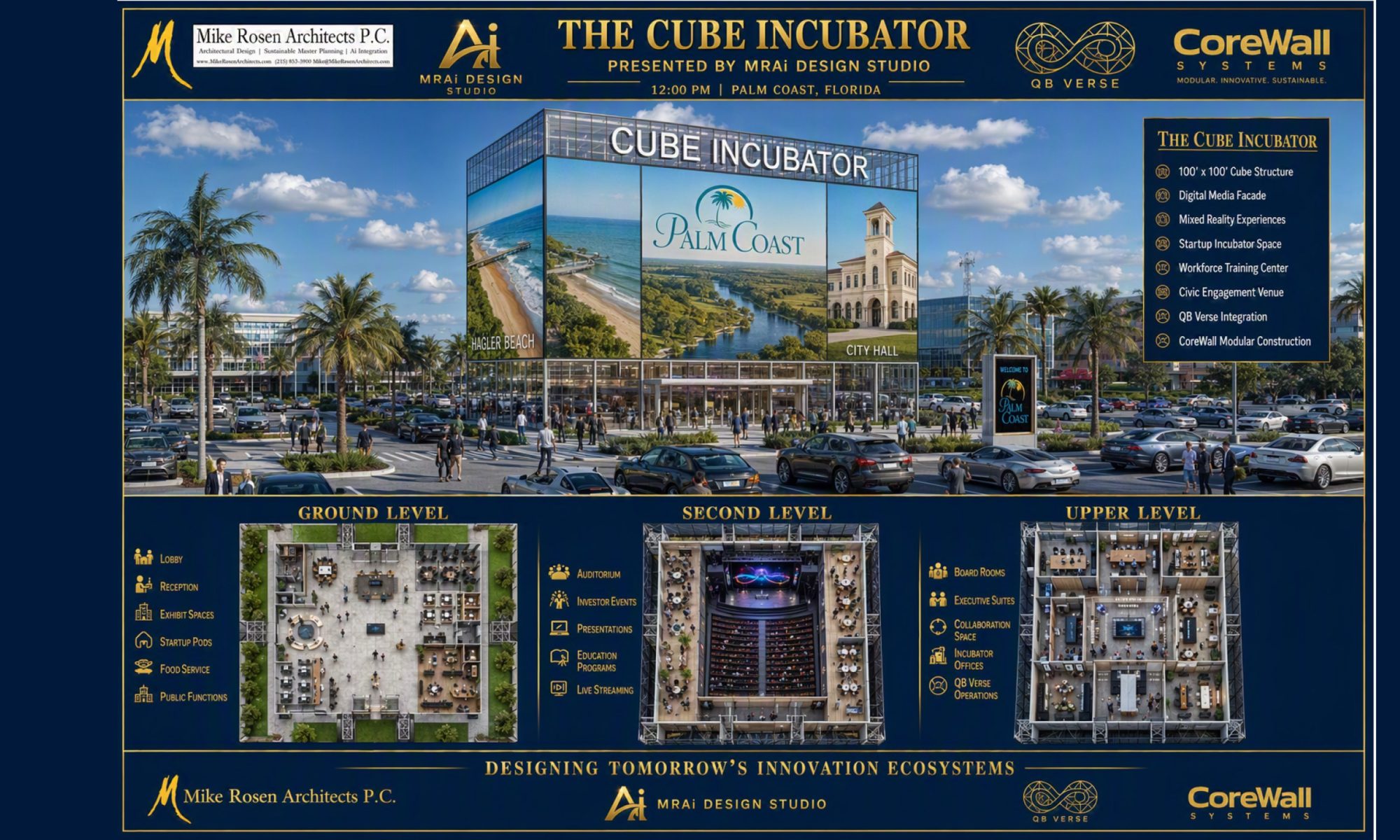
Today, Rosen lives and practices in St. Augustine, Florida, still running the firm he founded in 1988. He also leads MRAi Design Studio, the AI arm of his practice, where a team of trained AI agents works under his direction — in his words, he is “doing the same work and providing the same services as when I had 33 employees. But now the quality is better and I deliver it faster and for less money.” He trains AI agents on four decades of architectural knowledge and helps architecture firms integrate AI into their own workflows. He continues to develop CoreWall, his patented prefabricated wall system, and QB Verse — the cube-based spatial platform that descends directly from CubicEye, whose first commercial product is, once again, a browser. His U.S. patents cover both technology threads of his career: the CoreWall building system and the CubicEye 3D Internet technology (including U.S. Patent Nos. 6,938,218 and 6,922,815).
Rosen was the 66th architect in the world to attain the LEED AP ND designation (2011) and was a beta tester for the LEED ND exam. He served as co-chair of the ULI Carolinas Innovation in Housing Council. His work has been recognized by the Philadelphia Business Journal, Residential Architect, The New York Times, Computer Graphics World, and The Wall Street Journal, among others.
Experience:
2017–present — Mike Rosen Architects, St. Augustine, Florida — Principal. Re-formed the practice in the Southeast (Apex, NC, 2017; now St. Augustine, FL), providing residential, mixed-use, and retail services and sustainable master planning to the private development community, and leading MRAi Design Studio.
2018–2022 — Progressive AE, Charlotte, NC — Housing Practice Leader. Led the housing practice from a regional focus to a national practice, with large multi-family projects in nine states, spanning senior and healthcare facilities, affordable and LIHTC multi-family, market-rate, luxury, mixed-use high-density infill, and student housing.
2014–2017 — BSB Design, Philadelphia, PA — Principal & Market Leader for Sustainability. Principal in charge of the Philadelphia office and company-wide director of the sustainable practice; projects included the 420-unit Riverview CCRC (Plainsboro, NJ), the 380-unit Forestall Village (Princeton, NJ), a 143-unit all-DC net-zero apartment building (Lansdale, PA), and the winning entry in the 2017 Carolinas ULI Urban Ideas Competition (45-acre net-zero community near Charlotte, NC).
2009–2014 — The Martin Architectural Group, P.C., Philadelphia, PA — Principal. Principal and director of The Martin Green Studio; work included one of the first Platinum LEED-certified townhome developments on the East Coast (Sheldon Crossing) and a super-green mixed-use development in Hefei, China. Regular presenter and expert witness in zoning, legal, and trade-show venues.
1988–2009 — Mike Rosen Architects, P.C., Bala Cynwyd, PA — Founder and President. Full-service architecture, land planning, and landscape architecture; honors include the Best in American Living Award. (See the narrative above for the firm’s virtual-reality decade.)
2000–2009 — 2Ce Inc., Bala Cynwyd, PA — Founder, CEO and President. Founded to launch CubicEye, the patented 3D Internet browser; funded with over $3M of investment capital. [Replaces the prior “CubicEye Inc.” entry — see change log.]
2003–2009 — Eden Investments, LLC, Bala Cynwyd, PA — CEO and President. Established in 2003 to leverage real estate holdings and connect the firm’s clients in the development of raw ground through zoning approvals.
Professional Speaking Engagements:
International Builders Conference (IBS) every year from 1998 to 2025 on design, visualization, and building-related topics
Bisnow – 2013 to 2025 – Multifamily trends
China-2011 Expo Build China – Sustainable Architectural Design
Wharton School of Business -2002 Advanced Visualization application in business
China – 2001 – Cleo conference on 3D and the Internet
Singapore – 2000 – Urban Simulation
Israel – 2000 – Advanced Visualization in Architecture
Harvard University-Internet trends and visualization in the housing industry
Norway – 1998 – Advanced Visualization in Urban Design
Canada – 1998 – Residential Visualization techniques
Great Britain – 1997 – Immersive Virtual Reality
Israel – 1996 – AIA Virtual Reality Seminars (Haifa, Be’er Sheva, Tel Aviv)
Singapore – 1997 – A/E/C Systems Singapore (three seminars: VR Technology for Construction; Visualisation Technology in Architecture and Engineering; VR in Architecture and Engineering)
Publications:
Computer Graphics World: “Virtual Reality’s New Home” (April 1996) · “Philadelphia 2000” (June 1997, cover story) · 25th Anniversary Architecture Retrospective (June 2002) — TWO of his projects stand in the magazine’s official timeline of digital architecture: the Great American Virtual Home (entered at April 1996: “designed by Mike Rosen & Associates, debuts at the National Association of Home Builders conference”) and the ModelCity Philadelphia City Hall model (entered at June 1997)
Architectural Record – Automated Parking Systems
The New York Times: “Shaping Cities – Pixels to Bricks”
Business Philadelphia, May 1996: “The Virtual World of Mike Rosen”
WIRED, May 2001: “CubicEye”
Strategic Finance, March 2004: “The Web Through Dragonfly Eyes”
Patents:
https://patents.justia.com/inventor/mike-rosen
CubicEye,- 3D Internet Technology
CoreWall- New home technology delivery system. This technology has received international acclaim and has been used in many building projects sponsored by such companies as NextGen, Microsoft, Sharp Electronics, and Raising Malawi.org. TheCubivese – Metaverse Gateway Platform
Architectural Licenses:
Pennsylvania, New York,
New Jersey, Maryland,
Connecticut, North Carolina,
Delaware, South Carolina,
Florida, District of Columbia,
Virginia, Illinois
Education:
Temple University, Philadelphia, PA
Bachelor of Architecture, 1982
Professional Affiliations:
National Association of Home Builders (NAHB)
United States Green Building Council (USGBC)
American Institute of Architects (AIA)
Urban Land Institute (ULI) Co-Chair, Carolinas Innovation in Housing Council
Chair, AIA Housing Professional Interest Area (1998)